Holographic Pagan Press
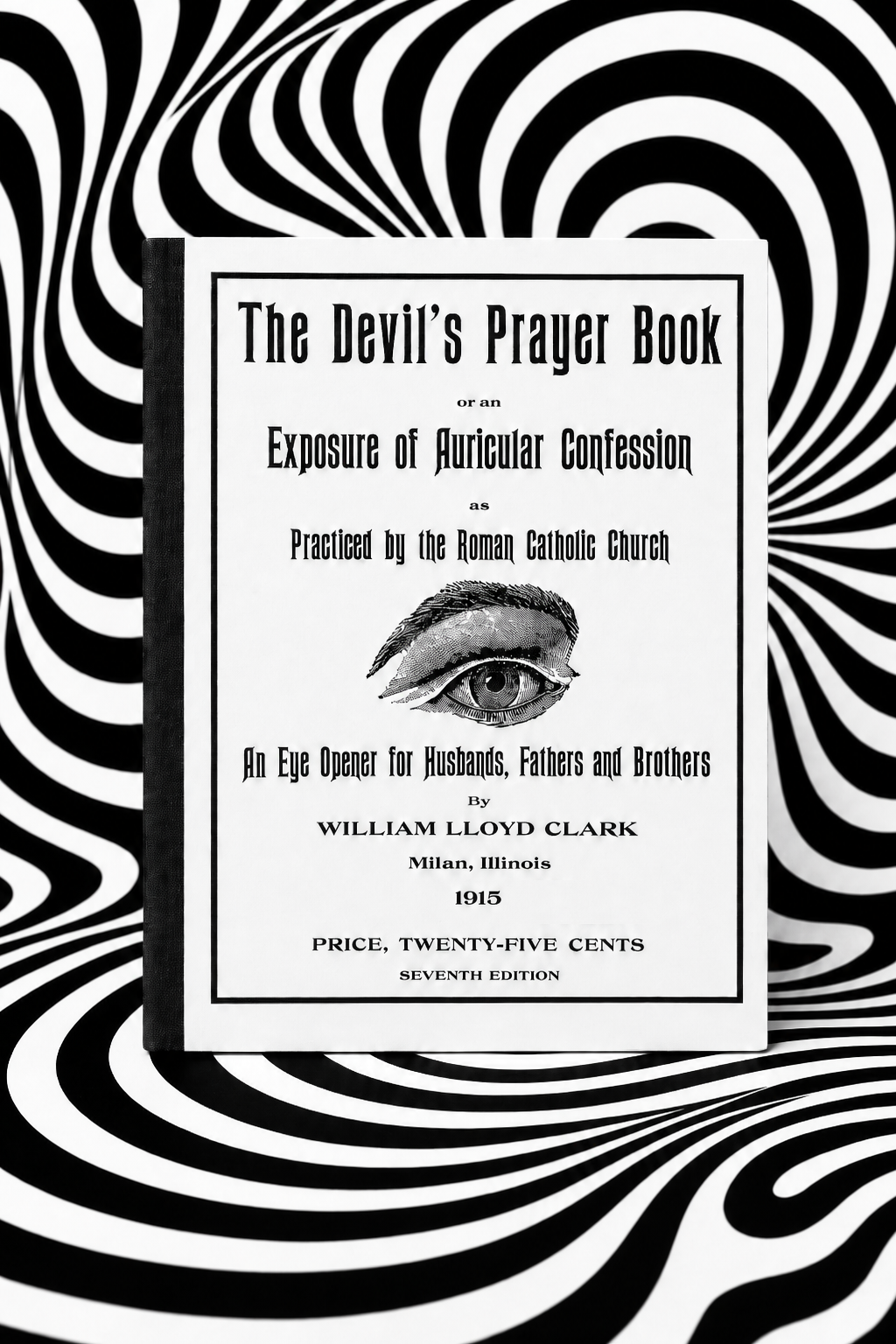
The Devil’s Prayer Book — William Lloyd Clark (1915)
The Devil’s Prayer Book — William Lloyd Clark (1915)
Couldn't load pickup availability
Edition Details
- Author
- William Lloyd Clark
- Original publication year
- 1915
- Edition publication year
- 2026
- Publisher
- Holographic Pagan Press
- Edition
- Holographic Pagan Press Edition
- Binding
- Black cloth tape-bound spine
- Condition
- New
- Available formats
- Digital PDF, Physical Book
- Subjects & traditions
- Religious History, American Religious History, Church History, Anti-Catholicism, Protestant Polemic, Pamphlet Literature, Propaganda, Religious Controversy
The Devil’s Prayer Book; or, An Exposure of Auricular Confession as Practiced by the Roman Catholic Church is William Lloyd Clark’s sharply polemical early twentieth-century tract on the Catholic confessional.
Physical edition: The Holographic Pagan Press edition is a handmade softcover book, not a hardcover.
Published in Milan, Illinois, this seventh-edition text presents Clark’s attack on auricular confession as an appeal to “husbands, fathers and brothers.” Its sensational title, engraved eye emblem, and confrontational rhetoric place it squarely within the anti-Catholic pamphlet culture of the period.
Beyond its controversial argument, the work survives as a revealing artifact of American religious conflict, Protestant nativism, print propaganda, and the culture of inexpensive reform pamphlets in the years before the First World War.
Current digital edition: The PDF currently available contains 13 scanned pages. It is a partial surviving scan.
Handmade edition note: Holographic Pagan Press editions are produced, assembled, and finished by hand in small batches. As a result, minute variations may occur between individual copies, including slight differences in materials, color, binding, trimming, placement, or hand-applied details. Materials may also vary slightly according to availability. We make every effort to preserve the intended design, character, and quality of each edition while allowing for the natural variations inherent in handmade bookmaking.
Title: The Devil’s Prayer Book; or, An Exposure of Auricular Confession as Practiced by the Roman Catholic Church
Author: William Lloyd Clark
Original publication: 1915, seventh edition
Original place of publication: Milan, Illinois
Printer named on cover: Grant W. Baker, Shelbyville, Indiana
Length: 13 scanned pages (partial document)
Format: Digital PDF
Interior: Black-and-white
Historical Note
The text contains strongly anti-Catholic arguments and reflects the religious prejudices and polemical culture of its period. It is reproduced as a historical document and not as an endorsement of those views.