Holographic Pagan Press
Chaldean Magic: Its Origin and Development — François Lenormant (1877)
Chaldean Magic: Its Origin and Development — François Lenormant (1877)
Physical editions are printed, assembled, and finished by hand in small batches. PDFs are digital reading editions and require no shipping.
Couldn't load pickup availability
Edition Details
- Author
- François Lenormant
- Original publication year
- 1874
- Edition publication year
- 2026
- Publisher
- Holographic Pagan Press
- Edition
- Holographic Pagan Press edition of the enlarged 1877 English text
- Binding
- Smooth black tape-bound spine
- Condition
- New
- Available formats
- Physical Book, Digital PDF
- Subjects & traditions
- Mesopotamian Magic, Assyriology, Demonology, Amulets, Comparative Religion, Incantations, Egyptian Funerary Texts
Holographic Pagan Press | Historical Editions
Near the beginning of Chaldean Magic, François Lenormant pauses over a small piece of evidence at the foot of a clay tablet. The scribe had written the tablet’s place in a series and the name of the work to which it belonged, The Wicked Spirits. From a few surviving lines, Lenormant could glimpse a whole collection of incantations copied for the library of the Assyrian king Ashurbanipal. Each formula had once answered an immediate human concern. Someone was ill, a household felt threatened, or a speaker sought the words with which to ask for protection.
Lenormant gives the incantations room on the page. A reader can hear the accumulation of names and the return of a refrain before encountering his account of the spirits themselves. His chapter on amulets carries the inquiry from the spoken word to an object a person could wear. Read together, these passages raise a question that runs through the book. Where did the protective power reside, in the words, in the object, or in the divine authority invoked through them?
That question gives purpose to Lenormant’s long comparison with Egypt. In the Egyptian funerary texts, the dead themselves can speak. Following the change of speaker opens a different way to read a ritual formula and to understand whom it was meant to protect. Later chapters trace Lenormant’s argument into the mythology of the underworld and the languages of the tablets. His use of terms such as “Accadian” also preserves the vocabulary of an early stage in Assyriology, when the relationship between language, people, and religious tradition was still sharply contested.
About the 1877 English Edition
Lenormant enlarged his 1874 French work for the English edition published in London by Samuel Bagster and Sons. He revised translations and added material. The editor, William Ricketts Cooper, supplied notes that let readers follow the scholarship as it was unfolding. One such note records when the cuneiform plates Lenormant had consulted in proof finally appeared in print. Details like this give the book much of its historical interest. We can follow an ancient text from a scribe’s copy to a printer’s proof and then into the hands of an English-speaking reader.
The Handmade Edition
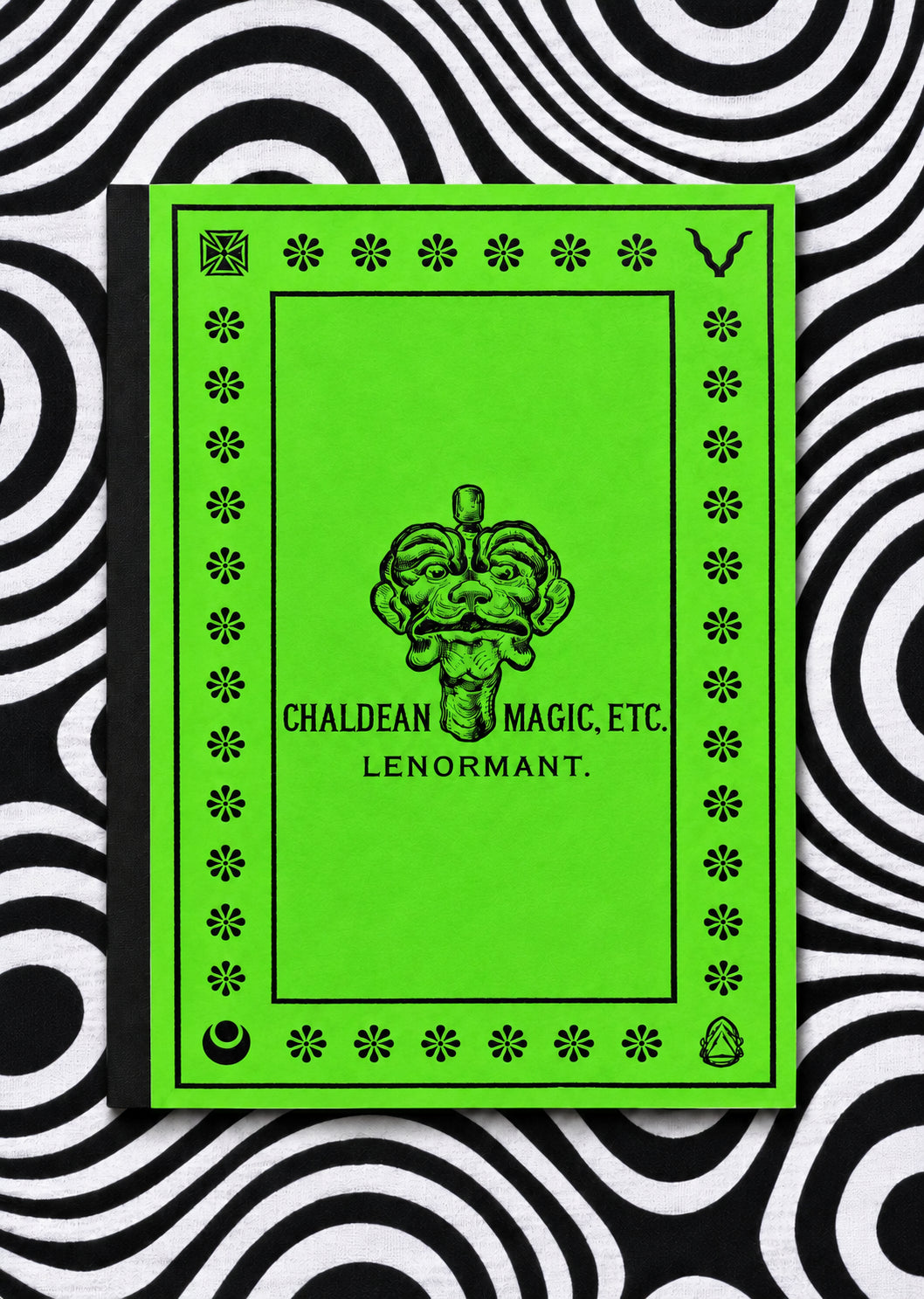
Holographic Pagan Press issued this edition in 2026. The green cardstock cover carries the historical binding’s rosette border and central head motif in black. Each 8.5 × 11-inch softcover is printed, assembled, and finished by hand with a smooth black tape-bound spine.
Choose Your Edition
Physical book — $95. The handmade Holographic Pagan Press softcover described above.
Digital PDF — $35. An electronic reading copy of the 1877 English text.