

Dion Fortune and Occult Psychology: Psychic Self-Defence, Qabalah, and the Inner Light
Dion Fortune (1890–1946), born Violet Mary Firth, was one of the most influential British occult writers of the twentieth century. Her work occupies a distinctive position between ceremonial magic, Christian mysticism, Qabalah, Theosophy, Spiritualism, and the emerging psychological vocabulary of her time.
Fortune’s importance is sometimes obscured by modern attempts to translate her occult language directly into contemporary psychology. Terms such as “psychic attack,” “thought forms,” astral influence, and magical polarity were not simply early names for nervous-system regulation, trauma, or interpersonal boundaries. They belonged to an esoteric worldview in which mind and imagination could operate beyond the individual psyche.
At the same time, Fortune did take psychology seriously. That combination—occultism interpreted through psychological language without being reduced to psychology—became one of the defining features of her work.

From Violet Firth to Dion Fortune
Fortune was born in Llandudno, North Wales, on December 6, 1890. Accounts preserved by the Society of the Inner Light describe her studying psychology and working for a period in a psychotherapy clinic before moving more deeply into occult study.
Her adopted name came from the family motto Deo, non fortuna—“by God, not fortune.” The pseudonym became inseparable from the body of work she produced across nonfiction, fiction, periodicals, lectures, and private instruction.
By the late 1920s, Fortune had begun to define a distinctly practical kind of Western occultism: skeptical of glamour and theatricality, psychologically alert, but still committed to ritual, initiation, subtle planes, and magical causation.

Sane Occultism and the problem of credulity
Sane Occultism is one of the clearest statements of Fortune’s method. It is not “skeptical” in the modern secular sense; Fortune accepted many claims about occult forces and nonordinary experience that are not established by modern science. But she repeatedly warned students against confusing emotional excitement, fantasy, status-seeking, or unstable interpretation with genuine attainment.
That tension is central to her historical importance. Fortune wanted occultism to remain occultism, while also insisting that practitioners cultivate judgment, discipline, and psychological self-observation.

Occultism after the Golden Dawn
Fortune entered several overlapping esoteric environments. She studied with Theodore Moriarty, participated in Theosophical circles, and became involved with the post-Golden Dawn order known as the Alpha et Omega. By the 1920s she was developing the independent organization that became the Fraternity of the Inner Light, later the Society of the Inner Light.
She inherited much from the late nineteenth-century magical revival: ritual correspondences, initiation, Qabalah, astral symbolism, and the idea of a structured Western Mystery Tradition. But she wrote for a new generation living after Spiritualism, psychoanalysis, and the first great wave of popular occult publishing.

Her books often ask what occult practice does to the mind of the practitioner. She warned against glamour, obsession, projection, imbalance, and the tendency to interpret every unusual experience as proof of spiritual attainment. This did not make her a modern clinical psychologist, but it gave her occultism a distinctly psychological tone.
Training, initiation, and the making of an occultist
Fortune’s 1930 The Training and Work of an Initiate made this emphasis explicit. Rather than presenting initiation as a decorative hierarchy of titles, she treated it as a demanding process involving character, discipline, service, symbolic training, and a reshaping of the practitioner’s inner life.
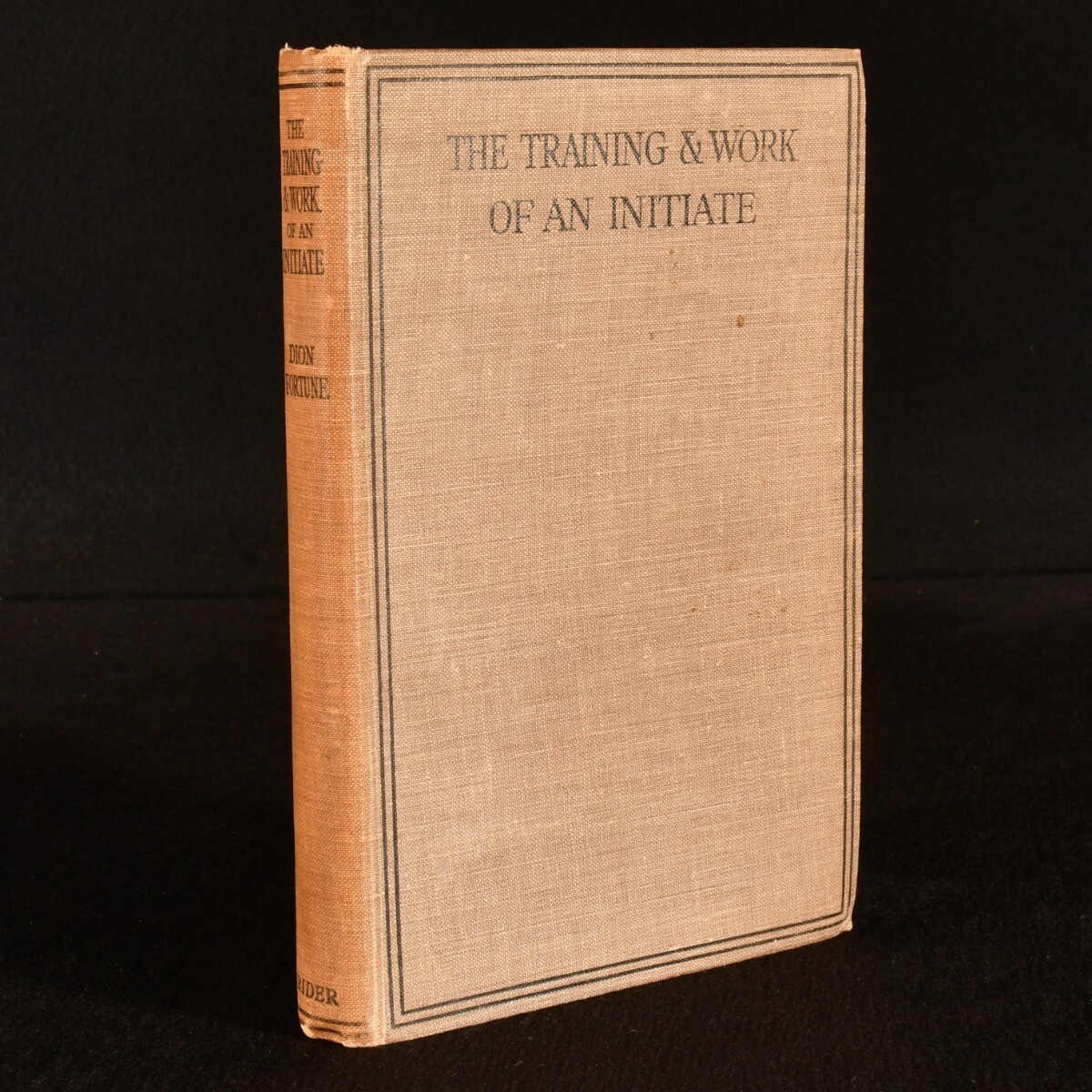
Seen beside Sane Occultism, the book helps explain Fortune’s long influence on later magical schools. She was not only writing about occult ideas; she was trying to define what a functioning esoteric institution should demand from its members.

Psychic Self-Defence
Fortune’s best-known book, Psychic Self-Defence, first appeared around 1930–31. It is a remarkable document of interwar occult culture because it treats “psychic attack” as a practical problem and mixes anecdote, magical theory, psychology, telepathy, mediumship, suggestion, and warnings about fraudulent or unstable practitioners.
Modern readers sometimes salvage the book by interpreting every psychic claim as metaphor. That approach can be useful, but historically it is incomplete. Fortune did not present psychic attack merely as a metaphor for manipulation. She believed that occult influence could in some cases operate through subtle or nonordinary means.
Those paranormal claims are not established modern science. They should be read as part of Fortune’s occult system. Yet the book remains historically valuable because it reveals how twentieth-century esoteric practitioners tried to distinguish spiritual experience from fear, suggestion, fantasy, obsession, and interpersonal conflict.
Thought forms, groups, and magical atmosphere
Fortune frequently wrote about thought forms: patterns generated or strengthened through concentrated imagination, emotion, ritual, and repeated attention. Within her esoteric model, groups could also create enduring psychic atmospheres.
There are obvious analogies to social psychology—groups do develop norms, moods, narratives, expectations, and identities—but those parallels should not be used as proof of Fortune’s occult mechanism. Her “thought forms” belonged to a magical cosmology, not to a modern laboratory theory of collective cognition.
The Mystical Qabalah
Fortune’s other enduring classic, The Mystical Qabalah, was published in 1935. It presents the Kabbalistic Tree of Life through the vocabulary of the Western occult revival, drawing on Hermetic Qabalah rather than functioning as a guide to Jewish Kabbalah in its religious and historical context.

That distinction matters. Western ceremonial magicians had already transformed Kabbalistic symbols through Christian, Hermetic, Rosicrucian, and magical interpretations. Fortune inherited that transformed system and made it unusually accessible to English-language occult readers.
Her treatment of the ten Sephiroth, the paths, divine names, planetary symbolism, and psychological states became formative for later British and American occultism. Many later readers encountered the Tree of Life through Fortune before encountering its Jewish sources.
Fiction as esoteric instruction
Fortune also used fiction to dramatize ideas that were difficult to communicate through manuals. Novels including The Sea Priestess, The Goat-Foot God, and Moon Magic turn ritual, polarity, landscape, initiation, sexuality, and psychic influence into narrative.
These works matter because modern esotericism was never transmitted only through textbooks. Novels, occult romances, visionary stories, and serialized fiction created imaginative worlds in which readers could encounter esoteric ideas emotionally rather than propositionally.
Christian mysticism, Glastonbury, and the Western tradition
Although Fortune is often grouped broadly with modern Paganism, her own system retained a strong Christian dimension. She was interested in what she regarded as a Western esoteric current running through Christianity, Qabalah, Hermeticism, ceremonial magic, Arthurian legend, and the Grail tradition.

Her career therefore resists simple labels. She was neither merely a Theosophist, a Golden Dawn magician, a Christian mystic, nor a psychological occultist. She combined materials from all of these environments and reorganized them around the institutional and teaching work of the Inner Light.
War, visualization, and magical resistance
During the Second World War, Fortune organized a program of group meditation and visualization that she and her associates regarded as an occult contribution to Britain’s spiritual defense. Later publications collected portions of this wartime correspondence.
This episode should be understood as religious and magical practice rather than military evidence that visualization affected wartime outcomes. Historically, however, it shows how seriously Fortune regarded imagination and ritual as collective forces. Her occultism was not confined to private mystical experience; she believed trained consciousness could participate in history.
Fortune’s later influence
Fortune died in January 1946, but the organization she founded survived her. Her books remained influential across ceremonial magic, Hermetic Qabalah, occult Christianity, modern witchcraft, Paganism, and magical psychology.

Her importance to later Wiccan and Neopagan culture is real but should not be flattened into a direct one-line genealogy. Later traditions selected and transformed different parts of her work—especially polarity, the Western Mystery Tradition, sacred landscape, ritual psychology, and the imaginative power of myth.
Where Fortune belongs on the historical map
Within the Odd Enough Books historical map, Fortune belongs to the twentieth-century branch where psychology and ceremonial occultism intersect. She comes after the Spiritualist and Theosophical revolutions, after the Golden Dawn, and after popular psychology had begun changing the language available to esoteric writers.
She is not part of the direct lineage from mental healing to New Thought, yet the worlds overlap. Both practical psychology and modern occultism increasingly treated attention, imagination, suggestion, habit, symbol, and inner states as forces capable of reshaping experience.
Fortune’s contribution was to keep one foot firmly in magic. Where New Thought often translated invisible causation into mental law or practical psychology, Fortune preserved ritual, Qabalah, astral symbolism, initiation, and the possibility of psychic realities beyond ordinary consciousness.
That tension is what makes her worth reading today. Her writings preserve a moment when the occult revival was learning the language of psychology without surrendering its metaphysical claims—and in doing so helped shape much of the esoteric culture that followed.
— C.K. Lee
Image/source note: nine historical or exact-source images are distributed throughout this feature at substantial display size. Public-domain, no-known-restrictions, or clearly licensed material includes Fortune’s historical portrait, Golden Dawn contextual material, Kircher’s 1652 Tree of Life, the Library of Congress Glastonbury image, and Robert B. Osten’s CC BY-SA photograph of Fortune’s grave. First-edition bibliographic reference photographs of Sane Occultism (1929) and The Training and Work of an Initiate (1930), including the latter’s title page, are reproduced for identification and historical commentary with source attribution and are not represented here as public-domain scans. Paranormal and magical claims are presented as elements of Fortune’s esoteric system, not as established modern psychological or scientific facts.

